Monday, June 11, 2012

No Stone Left Unturned [a Time-Telling Game]


Flash cards work. The only problem is, my son hates them. Don’t most kids? 

I cooked up a little game to sneak in some flash card-like time-telling practice.

I printed 16 clocks. On the back of the paper, were stone shapes. I also printed cards with the times from the clocks – some written out and others as numbers.

Once cut out, I laid the clocks face up in a four by four grid on the table.

Then I turned over one card at a time. My son’s job was to find the same time on the clock and turn that stone over. 


If he’d found all the times, all the stones would be turned over at the end of the game, when the pile of cards had all been gone through.


My son was anxious to see how fast he could identify the right times. (Maybe next time we'll see how quickly he can identify all the times correctly.) He truly enjoyed the game and when a neighbor boy stopped by, even he joined in the fun.

To make your own time-telling stones, download a PDF here. Print the first four pages of stones onto heavyweight cardstock. Flip the paper over and print page five through eight. The remaining two pages are the cards.

Friday, June 8, 2012

Hide & Seek Camouflage Game


My son wasn’t excited when I told him we were doing an activity all about camouflage. “I already know about camouflage animals, Mom,” he groaned. (sigh) I reassured him it would be fun and tossed a handful of his small plastic jungle animals on the table with a book I’d checked out from the library.

Curiosity definitely changed his mind.

To start, we read an absolutely captivating book written by David M. Schwartz and Yael Schy, with eye-tricking photos by Dwight Kuhn. This is actually the second book by the trio, but since our library system had the first checked out, we “settled” for Where Else in the Wild? More Camouflaged Creatures Concealed … and Revealed.


Oh my, was this fun! The book contains large-scale breathtaking nature photography with riddle-like poems that tease you into guessing the animal(s) hidden on the opposite page. Then readers lift the flap where the image is ghosted out, except for the camouflaged creature(s).

If you thought camouflage was just about frogs being green and leopards having spots, abandon this post and get to the nearest bookstore or library now. There were creatures familiar (e.g. crayfish) and far-out (e.g. Orchid Mantis) in this book. We learned so much and were eager to see what we could find. Sometimes it was easy, other times nearly impossible to spot the animals and insects.

This book was the perfect pairing for our little game. I gave my son his plastic miniature animals and had him imagine that our house was their natural habitat. It was up to him to find places where their coloring would camouflage them.

Off he went.

Forgive the pictures. He refused to let me see him hiding the animals because he wanted to challenge me to find them. And challenge me, he did!


Once they were found, he refused to move them. It was time for little brother to go a ’hunting. The fun continued then. And when Dad came home … yep, you guessed it … he was sent on a wild animal hunt, too.

So as it turned out, even though my son thought he knew everything there was to know about camouflage, he still learned something (did you know the snowshoe hare is white in winter then its coat molts and it is brown by summer? We sure didn’t!). He had a blast with our camouflage hide and seek game!

Wednesday, June 6, 2012

Miniature Multiplication Ring Toss


I’m not sure if I could even pass one of those elementary school math timed tests today. Math is just something my brain processes slowly. Thankfully, I’ve outgrown caring. Unfortunately, I still remember the feeling of anxiety and panic that those tests brought on. I hope my sons never feel that in school.

Even though my oldest son is a long way from mastering multiplication (he just finished first grade), anything I can do to simply expose him to the concept serves the purpose of easing the intimidation that he could otherwise feel later. Out of that desire, this game was born.

Before we played, we read If You Were a Times Sign, which is an ideal book for kids who have just been introduced to multiplication.


Multiplication is a fast way to add the same number over again and again.
The answer is the product.
The order of the numbers being multiplied can be reversed and the product is the same.
Multiplication is the opposite of division.
All of these little nuggets of math knowledge were playfully explained in Trisha Speed Shaskan’s book. It’s awesome!

Now my son was ready to practice his multiplication facts.

What You Need
2 plastic bottle-cap rings
1 square of thick Styrofoam
Wooden popsicle-like sticks (I used nine)
Number scrapbooking stickers (I used the numbers one through nine.)
Hot glue/glue gun


Push the wooden sticks into the styrofoam, evenly spacing them. Pull each one out and add a big glob of hot glue in the hole; replace the stick and hold in place until the glue dries and its secure. Add number stickers at the base of each stick on the styrofoam.

How to Play
Each player tosses the bottle-cap rings one at a time at the board, which is placed about two to three feet away. If the rings don’t land around a stick, they try again. If it encircles two sticks, the ring is removed and tossed again. 


Once two rings have been ensnared around the sticks, the player records the numbers and multiplies them for their Round 1 score.


My son used a multiplication table I made (download it here). 

The next player does the same. Who won Round 1? Play continues for four more rounds (five total), when each players’ rounds are added together.


The number will be high so have a calculator ready. Whoever has the highest number wins!

Monday, June 4, 2012

Clay Leaf Imprints (a Fossils Lesson)


You can’t talk about dinosaurs, without talking about fossils. Those prehistoric beasts sure get a lot of attention in books and on TV. While fossils of plants aren’t quite as impressive, they are just as important, giving scientists clues about what life was like millions of years ago.

our clay leaf imprints

To help my son understand fossils, we hit the nature trail. He collected leaves that had dropped from the trees. He was amazed at how many different kinds there were!


When the rain clouds moved in, we headed home with our bag of leaves. I grabbed a big box of white Sculpey clay. We rolled it into eight balls a little smaller than golf balls.


Then he smashed and rolled it between two sheets of waxed paper.


Next, he peeled off the top layer of waxed paper, added a leaf atop the clay, and then using a rolling pin, pressed the leaf into the clay.


Lastly, he peeled off the leaf and poked a hole using a drinking straw.


Now the only thing left to do was bake the leaf impressions, per the Sculpey instructions.


While they were hardening in the oven, we read about how fossils are formed in a book by Megan Lappi.


It’s true, we didn’t really make fossils; afterall, this activity took about an hour, not thousands of years it takes for fossils to form. But it sure was fun to preserve our leaves for future enjoyment!


Credit: These clay leaf imprints weren't my idea and despite combing my Pinterest boards, I can't find the original source to credit. If you've seen these online elsewhere, let me know so I can give proper credit.

Friday, June 1, 2012

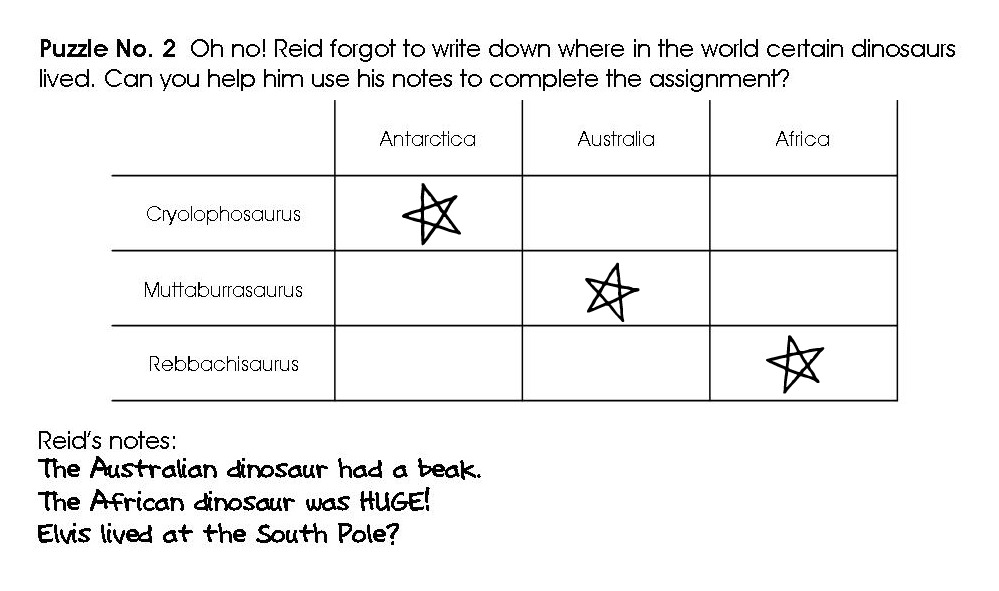
Dinosaur-themed Logic Puzzles


Now, even though my hatred of math started at a very young age, I always enjoyed doing logic puzzles. I remember “playing” them with my Mom as a young girl. (How's that for proof that my desire to trick my child into learning is hereditary?!?)

Banking on my son enjoying them as much as I did, I made some dinosaur-themed puzzles for him.

I used his National Geographic Dino-pedia to get some of the info.


My son knew a lot of the facts he needed to solve these puzzles, but when he got hung up, he used the book. All the boxes with possibilities that were eliminated were crossed out. This helped him narrow down the right answer (he colored these boxes yellow) for each question in the puzzle.


He matched dinosaurs to the right diet (carnivore, omnivore, or herbivore), figured out what countries different dinos lived in, and helped locate lost kids in the dinosaur museum! (Download the puzzles and answer sheet here.)


These three logic puzzles are a great precursor to higher level deductive thinking. And even those kiddos who struggle with math will enjoy them!


For more great logic puzzles (in loads of themes), visit
EnchantedLearning.com.