Showing posts with label Grammar. Show all posts
Friday, April 8, 2016
Pick the Punctuation (Period, Exclamation Point, & Question Mark)
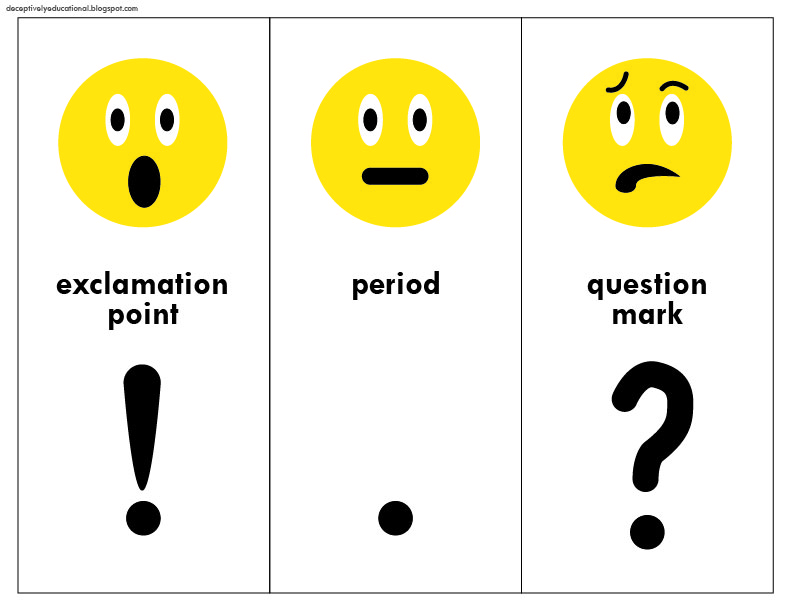
The kids in my youngest son's kindergarten class are working hard on their writing skills. The teacher has been talking a lot about end punctuation and reading with fluency (i.e. NOT like a robot).
I thought it would be fun to test my son with a quick game to see if he could pick the right punctuation for sentences I read to him.
I made some fun cards with visual cues for him to use.
Want to play this? Here's what you need:
the 4-page PDF (download it free from Google Drive here)
heavyweight card stock to print the PDF on
scissors/paper cutter
time
To play, simply put the three punctuation cards in front of the child. Now mix the assorted sentence cards. Read them to your child with inflection and intonation. When the statement should have an exclamation, proclaim it excitedly. When your asking something, make sure the pitch of your voice goes up at the end. Sentences ending in a period should be read with a flat tone.
If the child holds up the correct punctuation card for the sentence you read, they get to keep the sentence card. They can add up their score at the end and play with different sentences the next day to try and beat their personal best.
The sentence cards are just to get you started. Make up your own. Change them to reflect your child's interests and family. Get creative! Get silly! Make it personal.
For as simple as this was, my son really enjoyed it. I hope your kiddos will too!
Friday, January 10, 2014
What Gets a Capital Letter? (Board Game)
It can be a real struggle to remember what to capitalize
when you're eight years old. And since grammar doesn't stick like math does for
my son, I wanted to find a fun way to help him learn.
The What Gets a
Capital Letter game is a sneaky way to trick kids into remembering that the
following are always capitalized:
Days of the Week.
Months.
Names of holidays.
Names of people and pets.
Names of places.
The beginning of a sentence.
The letter "I" when it is a word.
Download a PDF of the game for free on Google Docs here.
It's an easy game with very few rules. Game pieces (we
used laminated photos inside binder clips) are placed on the START. The
youngest player starts the game by drawing a card from the deck. He/she reads
the card and identifies what in the sentence needs to be capitalized and why. Then,
the player moves his game piece to the first occurrence of that reason on the
game board.
For example, a player might draw the following card:
kiwi fruit is so delicious.
He/she would then say "kiwi needs to be capitalized;
it's the beginning of a sentence," then move their game piece to the first
blue box on the game board that reads "beginning of a sentence."
Now it's the opponent's turn. Play alternates between
players.
If a player draws a "GO BACK" card, he/she must
draw another card and instead of advancing based on the reason for
capitalization, they'll retreat. If the player is too close to the start and
there's no "months" box, for example, to move back to, their game
piece remains in its place.
If players are near the end and draw cards with reasons
for capitalization without any remaining boxes, they must still say aloud the
correction and reason, but do not advance. The first player to land their game piece
on the final "days of the week" box wins the game!
To accompany this game, my son read Kick Ball Capitalization by Michael Ruscoe. It covers many more
reasons for capitalization in a very fun way!
Friday, October 18, 2013
Pasta Apostrophe Catastrophe
The apostrophe is SUCH a hard working piece of punctuation.
To review how it's used in contractions and to show possession my son and I
grabbed a great book and some elbow macaroni.
I wrote a fun story for my son about Punctuation Pete who
acts out by stealing apostrophes from Marley's town. By showing kindness to
him, the apostrophes are returned and grammar is restored to the city.
Friendship mends the apostrophe catastrophe!
The story was segmented into 15 cards and the apostrophes
were eliminated from the text. A number (i.e. 1, 2, or 3) was added to each
card to indicate the number of apostrophes that are missing. I printed, cut
apart, and scrambled the order of the cards.
![]() |
| Download a 5-page PDF of these segmented story cards from Google Drive here. |
Before all this grammar greatness could ensue, we read
an incredible book, which served as the inspiration for this activity.
The Girl's Like
Spaghetti: Why You Can't Manage With Apostrophes! shows kids how the use
(or lack of) an apostrophe changes the meaning of a sentence.
For example, one 2-page spread shows the difference between "Those smelly things are my brother's", where children stare and point to a pair of filthy sneakers, and "Those smelly things are my brothers", where a group of children with clothespins clipped on their noses run away from two young boys playing among dirty trash.
My son spent a long time studying the pictures and the
sentences to really understand the way one simple punctuation mark could make
such a huge difference.
After we were finished reading Lynne Truss' book, I pulled out the
segmented story cards. With some school glue and dried elbow macaroni (the pasta
apostrophes), my son added the missing punctuation.
And then put the story in order as best he could.
This was a simple review of one very important piece of
punctuation. It was fun too!
Friday, June 14, 2013
Proofreading with DIY Punctuation Stamps
What is it about stamps? I've known for years that the most mundane learning activities seem less of a chore when there's an ink pad involved (for evidence, check out our Missing Letters Mystery). Don't ask me why.
To practice punctuation, we reviewed seven punctuation
marks: apostrophe, comma, exclamation point, period, colon, and semicolon.
In order to do this, we read Punctuation Takes a Vacation, a clever book about a classroom of
students that get a taste of life without any punctuation. This is my favorite
kind of children's book - non-fiction disguised as fiction with playful
graphics and a creative storyline. I enjoyed it as much as my son did.
And just as importantly, it was the perfect complement to this activity.
I printed two pages of sentences with missing
punctuation. Download them here.
Then I made some punctuation stamps.
These were surprisingly easy. I used six wine corks that
I'd been saving for ages (a friend mailed me a gift and used them as
packaging), six 1-inch wooden discs, 3mm craft foam, and a low-temp glue gun.
I cut the punctuation marks out of the foam, using a hole
punch when possible to get perfect circles, and glued them to the wooden discs.
Then, I glued each disc to a cork. NOTES: Make sure your stamps are the mirror
image of your punctuation marks. Also, you only need one stamp for the comma
and apostrophe.
When it came time to fix the missing punctuation on the
sentences I'd prepared, my son was ready. He moved through them quickly, only stopping
a few times to ask questions for help.
He happily stamped and stamped and stamped.
Thursday, April 4, 2013
There, Their, or They're: You Be the Judge
My son got off the bus last week with a long face. He'd
failed the pre-test and came home with the easy list of spelling words. I was
surprised; he's good at spelling. As soon as he handed me the list, I understood.
There. Their. And they're. That's what had happened.
Not only had his teacher expected him to spell them
right, but he needed to know when to use which one in a sentence. My son had
totally botched it up.
Those three words sound EXACTLY the same but are used
COMPLETELY differently. How confusing!!
To help him study, I gave him a little lesson with some
tips and tricks.
There
Within this word is another word: here. There usually represents a place.
Very often, if you can substitute here in place of there,
you've used it correctly.
Their
This is a possessive pronoun. I reminded my son that
"I" was also a pronoun, which was a hint to help him remember that
this their is the only one spelled
with an i.
If you can replace their
with our and the sentence still makes
sense, you've used it correctly.
They're
Among these three words (there, their, and they're), this
is the only one that is a contraction. It's an abbreviation for they are.
If you can put they
are in place of they're, you used
the right word.
Now it was time to put his knowledge to the test.
![]() |
| Download a 1-page PDF of this worksheet here. |
"You be the judge," I said. "Read the sentences on the post-it
notes and decide if the correct there, their, or they're was used."
I reminded him that the scale on my DIY worksheet needed
to be balanced, so an equal number of sentences should be on the incorrect side
as the correct side.
This took LOADS of thought and he referenced the cheat
sheet of hints I made several times. I was so proud when he caught two
misplaced sentences moments before handing me the worksheet to check. He'd
sorted all the sentences correctly!
I gave him eight sentences to sort. Here they are, along
with some extras we'll be using for future practice:
Correct:
I put my shoes right there.
It was their team's turn to answer.
They're my favorite band!
There is the book I lost.
Their car is blue, not grey.
I asked, but they're out of town that day.
Let's go there.
Their house is the one with the picket fence.
They're too short to ride the roller coaster.
Incorrect:
Their are no cookies left! <<should be there>>
There excited for the party. <<should be They're>>
Why didn't they listen to they're teacher? <<should be their>>
Are we almost they're?
<<should be there>>
Their daydreaming, instead of listening. <<should
be they're>>
There project was the winner. <<should be Their>>
My favorite pizza place is right their. <<should be there>>
I can't see them; there too many people here. <<should be they're>>
Lots of people are stopping at there lemonade stand.
<<should be their>>
Thursday, March 14, 2013
Run-On Repair [a Grammar Activity]
My son has been known to forget end punctuation. Hence,
the run-on sentence occurs. To give him a little grammar lesson on why run-ons
are bad, I grabbed a roll of register tape and an Easy Reader Level 1 book.
I copied the words from the book onto the register tape
omitting end punctuation and capital letters. I stuck with a fairly short book,
as the text gets kind of long regardless.
When my son got home from school, I was ready with the
register tape, scissors, pencil, and the stapler. Before he did our language arts activity, though, I pulled out a Grammar Tales book to help me explain just why
run-ons are so troubling.
This is our third experience with a book from the series and The No-Good, Rotten, Run-On Sentence didn't disappoint. It's the story of Kevin Crabtree whose great idea for a story became the longest run-on sentence in the history of writing (okay, I might be exaggerating just a bit). The first sentence ran and ran, right off the page and all over town.
Finally, after many feeble attempts to catch the
sentence, dear Miss Bartlebine comes to the rescue with her red pencil. The
ridiculously long run-on was finally tamed into perfectly polite sentences
with punctuation or by adding words like but, yet, for, because, or and.
Now it was time to apply what he'd learned.
I handed him the run-on story I'd copied and reminded him that sentences contain both subjects and verbs and always have complete ideas (i.e. no fragments).
He worked his way through reading the register tape, stopping to analyze where adding punctuation would make the most sense and capitalizing the first word of the new sentences.
Snip! He cut the register tape into shorter sentences that we kept in order and stapled together when he was done.
I handed him the run-on story I'd copied and reminded him that sentences contain both subjects and verbs and always have complete ideas (i.e. no fragments).
He worked his way through reading the register tape, stopping to analyze where adding punctuation would make the most sense and capitalizing the first word of the new sentences.
Snip! He cut the register tape into shorter sentences that we kept in order and stapled together when he was done.
Thursday, January 24, 2013
Missing Punctuation Board Game [printable]
It's not exactly a secret; the English language is
confusing. If I'm saying this after spending the last 12 years writing
professionally, I can only imagine what it's like for a second grader! To help
my son understand what punctuation to use when, I grabbed an amazing book and
created a fun board game for us to play and practice.
Before we got our game faces on, we read Elsa Knight
Bruno's book Punctuation Celebration.
This book is to kids what the AP style guide is to grown-up journalists (only
WAY more whimsical). This is the most interesting reference book I've ever read!
The book explains in rhyming text how 12 pieces of punctuation are used. The explanations are simple and examples are included. Illustrations are playful (Is there anything more cute than a smiling semicolon jumping rope?), making the weighty topic less intimidating. Whether your child is showing a natural talent or interest in writing or not, this book is worthy of checking out from the public library or adding it to your own shelves at home!
Once we were done reading, I got out the Missing Punctuation
board game I'd made.
You can download a PDF of the 2-page game board and game
cards here. You'll need to tape the game board together and cut out the cards.
Find a few buttons, magnets, LEGO minifigures, or anything else that's small to
use as game pieces (each player needs one to mark their progress moving around
the board). NOTE: I created the game for
two players. If there are more, you may need to make additional game cards.
The game cards each contain a sentence or two with missing
punctuation. It's up to the player to figure out which one is missing among the
following:
Period.
Exclamation Point.
Question Mark.
Comma.
Apostrophe.
Quotation Marks.
Colon.
Semicolon
Parentheses.
Hyphen.
Once they have figured out what punctuation is absent,
they move their game piece to the space where that punctuation occurs on the
game board. NOTE: You may need to remind
players of the difference between an apostrophe and a comma. Play alternates
between players.
I gave my son loads of hints (e.g. for quotation marks, I
asked, "Is someone talking?" and for parentheses, I posed the
question, "Is there any information in the sentence that could be removed
and it would still make sense?"). We referred to Bruno's book a lot and it
was slow-going but my son had lots of fun and when he got a card with the final
answer of exclamation point and won the game, he was elated!
"Can we play again sometime?" I asked.
"You bet!" he answered enthusiastically.
Here are the answers:
"I would like a turn," said John. Quotation
Marks
"Pass the ball," yelled the coach. Quotation
Marks
"Thirty-six," answered Julie. Quotation
Marks
"Write your name on the paper,"
said the teacher. Quotation Marks
Are you okay? Question Mark
Do you want a cookie? Question Mark
Dogs are furry. Period
Ethan is sad. Period
His t-shirt was red.
Hyphen
I am very thirsty; I need a drink of water. Semicolon
(or Period)
I can't find my hat, coat, or mittens.
Commas
I can't swim. Apostrophe
I don't care. Apostrophe
I have a dog, cat, and hamster.
Commas
I like blue. Period
I went to sleep at 8:35. Colon
If I was older, I could drive.
Comma
I'm allergic to nuts; they make me sick. Semicolon
(or Period)
In my bag are three things: a pen, pencil, and eraser. Colon
It is cold outside; I'm shivering.
Semicolon (or Period)
It was a part-time job.
Hyphen
Katie's nose is running. Apostrophe
My cousins are leaving; I am sad. Semicolon
(or Period)
My sister wants four things: a doll, book, crayons, and a
dress. Colon
My umbrella is broken. Period (or Exclamation Point)
One-fourth of the pie is gone. Hyphen
OUCH! Exclamation Point
Pickles (that I hate) are too sour.
Parentheses
Somebody help me! Exclamation Point
The doctor took x-rays of my finger. Hyphen
The milk (that was sour) spilled all over. Parentheses
The radio (that was too loud) was playing my favorite song. Parentheses
The school is on fire! Exclamation Point
These cupcakes (from the bakery) are yummy! Parentheses
This is my dad's hammer.
Apostrophe
Watch out! Exclamation Point
We didn't eat lunch until 1:00 p.m. Colon
What's your favorite color?
Question Mark
Where were you? Question Mark
While I was sleeping, the tooth fairy came. Comma
Friday, December 28, 2012
Top 10 Favorite Language Arts Activities of 2012
This mama is a word nerd ... and proud of it. These
activities were created to help develop my son's reading and writing skills. Who
knew language arts could be so fun?!?
No.1 Proofreading Police
Your child joins the proofreading police squad and
examines evidence of grammar crimes. This activity has four great downloads and
a must-read book recommendation. Find it all here.
No.2 Homophones Memory Game
Words that sound the same but mean very different things
can certainly trip kids up. A fun game of memory makes matching homophones a
blast. Two of the best children's fiction to pair with this activity are also recommended.
Free printable game cards here.
No. 3 Compound Word Card Game
Compound words are especially fun when you learn them while
playing a card game! Free printable game cards and instructions here.
No.4 Race Around the Nouns, Verbs, & Adjectives
Game
Toss out the worksheets! Kids can test their
understanding of nouns, verbs, and adjectives by playing a fun board game.
Directions and downloads here.
No. 5 Word Dominoes
Children LOVE dominoes! Why not make some to have them practice
matching words with their respective parts of speech: nouns, adjectives,
pronouns, and nouns? Free download, DIY instructions, and game directions here.
No. 6 Word-Eating Whale
Turn an empty milk jug into a whale that's hungry for
nouns, verbs, or other parts of speech. Kids will love scooping up bottle-cap
words with their whale! Directions here.
No. 7 Pronoun Practice to the Moon and Back
Capitalize on kids' love of space, by challenging them to
replace nouns with the correct pronoun in a race to the moon. The more right
answers, the closer your child gets to the moon. Keep going and the rocket on
his/her scorecard will come all the way back to earth! Everything you need - plus
a great book recommendation - is here.
No. 8 Adjective Detective
Time for some super sleuthing with two amazing adjective
detective activities: a treasure hunt and an adjective search-and-solve code
story. Instructions, a printable, and cool adjective detective spy
"glass" download are here.
No. 9 DIY Newspaper
EXTRA! EXTRA! Kids put on their reporter hats and record
all the big stories in their lives with this fill-in newspaper template. Free
printable here.
No. 10 Alphabetical Adjectives
Put the adjectives in alphabetical order by connecting
the dots! Head here
for a great book recommendation and free printable.
Friday, May 4, 2012
Proofreading Police
My son’s first-grade teacher is working hard to help the
students, my son included, understand the writing process and the importance of
proofreading. To reinforce her efforts, I created a fun activity to give my son
some practice editing.
Having spent much of my professional career as a writer and
editor, this activity is close to my heart.
To start, we read a book from the Grammar Tales series. Francine Fribble, Proofreading Policewoman
by Justin Martin was the perfect book to illustrate just how important
proofreading is.
The story follows Francine on her beat as she heads through
town correcting bad grammar (improper or forgotten capitalization, bad
spelling, and lack of apostrophes and other punctuation). My son loved it!
When he was done, I told him it was time for him to join the
proofreading police squad. He was excited!
I gave him four cases to review. Each profiled one kid (Too Busy Tina, Careless Kyle, Unsure Ursula, and Forgetful Frank). Download them here.
Subscribe to:
Posts (Atom)