Showing posts with label Fractions. Show all posts

Friday, February 5, 2016

Homework Help: Multiplying and Dividing Fractions


Our 10 year old was given the opportunity to do sixth grade math in fifth grade. We were psyched that he was going to be challenged more in his favorite subject. The program is pretty much self-taught and while it's gone well, there has been one hiccup ... fractions.

My son normally does mental math at the speed of light, but fractions ssssslllllllllloooooowwwww him way down and that's pretty frustrating for him.

As he struggled through his homework, I agonized over a way to help him. While it's true that games and activities are always my first choice, I knew he was going to need some kind of cheat sheet to refer to as he worked through page after page in his workbook.

Hence, this printable was born.


Seeing as though my fraction activities continue to be some of my most popular, I'm guessing you followers (and the kids you work love and teach) will find this useful.

Print the PDF free from Google Drive here. 

Teachers - if you're prompted to request permission to access the document, use a PERSONAL email address. Most schools block emails from outside their domain, prohibiting me from granting you access.

Wednesday, January 20, 2016

Fraction, Decimal, and Percent Puzzles (free printable)


Good golly, converting fractions to decimals and percents can be a challenge. To help our 10-year-old memorize some of the most common ones, I created a series of 3-piece puzzles that are self checking.


Download the 4-page PDF of the puzzles for free from Google Drive here.


Construction
I wanted my pieces to be thick so they'd stay together. In order to do this, I glued the printed puzzles onto thin sheets of craft foam (I recommend FOAMIES glue). I then glued various scrapbooking papers (a different design for each puzzle) on the back. Lastly, I used a exacto craft knife to cut the pieces out once the pieces were totally dried.

Truthfully, it was a pain. While I achieved my objective, if I had it to do all over again, I'd skip the craft foam and just glue the scrapbooking papers to the backs of the puzzles and maybe laminate (for durability). Cutting them out would be MUCH easier.


Play = Practice
I dumped them all number side up in front of my son and let him work through finding each 3-piece puzzle, matching 0.5, 1/2, and 50%, for example. When he thought he had all three pieces of a puzzle found, he turned them over to check that they all had the same paper on the back. Voila! That's the self-checking part.

The papers are necessary because not all the puzzles have different shaped pieces.


My son really loved this challenge!

Wednesday, September 2, 2015

Adding Fractions Tic-Tac-Toe {free printable}


Tic-tac-toe is a favorite of my oldest son's. We have passed many minutes playing the age-old game on children's menus at restaurants while we waited for our food.

To add a little math practice in, I made four tic-tac-toe game boards with fraction addition problems. To start, these boards only have problems with like denominators that only add up to 1 or less.

Download the boards I made for free from Google Drive here. There's a blank page of boards too so you can write in your own problems!


Prep
I printed the boards on cardstock and then slipped them (front and back) inside a plastic sheet protector. I trimmed it down and grabbed two different colors of dry-erase markers. 

No sheet protectors? No problem. You can also laminate the cards or place a clear plastic report cover over the pages so the dry-erase marker wipes clean and you can reuse them again and again.

Play
This game of tic-tac-toe has no Xs or Os. Instead players select their space on the board, solve the fraction addition problem and mark the spot with the answer in their colored dry-erase ink.


Play alternates between players until either the board is filled or one player gets three problems completed in a row (horizontally, vertically, or diagonally).

Friday, August 28, 2015

Multiplying Domino Fractions


Fractions can be challenging for kids. I thought I'd see how my 10-year old son would do multiplying fractions.


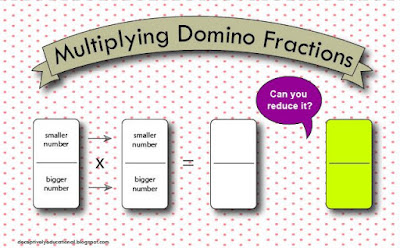
I made some fun game cards, which I laminated, and got out our set of dominoes and two dry-erase markers. I put the doubles aside (i.e. six six, four four, etc.) and turned the rest of the dominoes upside down on the table.

Download a free one-page PDF with two game cards from Google Drive here.


He drew two dominoes from the pile and placed them on the game card. 


Then he multiplied the numerators and the denominators, writing the numbers on the card with a dry-erase marker. Stumped? Watch this great video from Khan Academy.


Lastly, my son reduced the fraction to its lowest terms, if he could.

Now it was my turn. I did the same thing with my game card. Lastly, I asked him to compare our final answers. Whose fraction was bigger?


If it's not readily apparent, we looked for a common denominator. Confused? Watch another Khan Academy instructional video; this one is great!

The player with the largest fraction takes the four dominoes. With a limited set of double six dominoes, we were able to play three rounds.

With the cards laminated, the dry-erase numbers you add can be wiped clean with a paper towel.

The player with the most dominoes in the end wins. My son really enjoyed this and asked to play it again; it's fun skills practice!

Wednesday, April 1, 2015

Equivalent Fractions Missing Numerator Board Game

My 9-year-old son is a whiz at math facts. He's had them all down since before he started fourth grade. But fractions can be tough. I wanted to test his multiplication fact skills by playing a game to make equivalent fractions.


The game I made is simple. (Those always seem to be the most fun.)

You can download the 5-page PDF for free from Google Drive here. I printed two sets of cards. We used two LEGO minifigures as game pieces.

Players advance around the game board by finding the missing numerator on playing cards printed with equivalent fraction equations.


The missing numerator is the number of spaces the player moves.


If they STOP (i.e. the last space in their count) on a space with GO BACK instructions, they must move toward the start the number of spaces noted. 

If a player STOPs on a space that has the back-end of an arrow, they can follow the arrow and skip spaces on the board.


The first player to make it to the finish wins.

Friday, March 27, 2015

Butterfly Garden (a Comparing Fractions Game)


Fractions seem to be tough for kids to conquer. To help our 9-year-old son compare fractions with different denominators to see which was bigger, I wanted to teach him a quick and easy shortcut. 

Of course, learning is always more fun when you have the chance to go toe-to-toe with your mom and try to beat her. To facilitate that opportunity, I made the Butterfly Garden Fractions Game.


This game uses the cross multiplying method (or butterfly trick) to determine which fraction is greater than the other. If you're not familiar with this method, watch this YouTube video.


What You'll Need to Play Butterfly Garden
2-page PDF (game board and score card)
Paper
Lamination or a plastic sheet protector
fine-tip dry-erase marker
die
Writing tool or butterfly stamp for keeping score


Click on the picture above to download a 2-page PDF free from Google Drive. Once you've printed both the game board and score card, place the game board inside a plastic sheet protector or laminate it. Now you're ready to play.

How to Play
The first player will roll the die twice. The larger number that is rolled will be the DENOMINATOR. The smaller number will be the NUMERATOR.

Record the fraction on the butterfly game card on the correct side of the butterfly's wing.

Once the opponent has done the same, compare the fractions using the butterfly method.


Whoever has the bigger fraction wins the round and can indicate that on the scorecard; we used a rubber stamp of a butterfly.

The player with the most markings or “butterflies” on the scorecard after eight rounds of play wins!


And in case you're wondering, I got creamed. My boy won 6 rounds!!!


Friday, February 20, 2015

Roll and Make Whole (Adding Fractions Board Game)


My son's fourth grade class has been revisiting fractions lately. I thought I'd test my son's knowledge a bit and make a fun board game.


Roll and Make Whole practices two skills:
1. Reducing fractions to their lowest terms (i.e. simplifying fractions).
2. Adding fractions (sometimes with different denominators) to equal one.

It didn't take long for my son to catch on to our game and even though I won (which almost NEVER EVER happens) he was a good sport and hours later was still talking about the fractions.

Supplies
3 pages heavyweight cardstock
Different game pieces, one for each player (we used oversized buttons in two different colors)
Scissors (to cut out the die)
Hot glue (to hold the die together)
Tape (to tape the game board together)


How to Play
All players put their game pieces on the start square. The youngest player rolls first. Whatever fraction is revealed on the top of the die when it stops moving, is one part of a fraction addition problem. For example, if the player rolls a 2/5, they must ask themselves, "what fraction do I need to add to 2/5 to make one whole?"

They'll then look at the board and find the first occurrence of either 3/5 or another fraction that can be reduced to 3/5 (e.g. 6/10 or 9/15).


Their game piece will then be moved to that square. If a player rolls LOSE A TURN, their game piece remains in its place and an opponent gets to roll and move. If a player rolls ROLL AGAIN, they must do as the die says.

When players near the end, they must roll 2/3 to win, as 3/9 is the final square on the board. The first player to arrive at the finish wins.

Wednesday, October 8, 2014

Equivalent Fractions Pegboard Practice


Reducing fractions (or equivalent fractions) is part of my oldest boys' fourth grade curriculum. And since he's ahead of the class when it comes to math, I figured I'd give him an introduction at home before they start tackling the topic at school.


To do this, I made a page for him to match equivalent fractions using our pegboard (see how I made our wood and nails pegboard here).

What I love about these pegboard pages, are that they're like multiple choice questions. He has a limited number of answers to choose from so it's not overwhelming and all you need is a nontraditional hole punch and rubberbands to practice an endless amount of skills.

Download this 1-page PDF here.


My son did great stringing rubberbands from one nail to another to match the equivalent fractions!


Friday, June 6, 2014

Triangles to Squares Take-a-Long Game


Have you ever played dots and boxes? It's an astounding simple game that is perfect for passing the time. This little game fits that description as well. Critical thinking gets snuck in while kids play.


What You Need
PDF of triangles/squares (download it here)
Cardstock (2-5 sheets)
Small drawstring bag or plastic sandwich bag for transport/storage
Notepad and pencil for scorekeeping


Simply print the PDF on cardstock, cut out and get ready to play. If you want to increase the durability of the game, either laminate the pages before cutting out the squares or use foamies glue and adhere the paper to thin sheets of foam and use a straight edge and craft knife to cut out once dry.

To make the game car-friendly, buy a metal clipboard to use for storage and playing surface, shrink and print the pieces on sticker paper, and adhere them to thin magnetic sheets.

There are five pages in the PDF I made. For a short two-person game, only two pages of game pieces are necessary. Play is extended with more pieces. Likewise, for more players, you need more pieces.

The Objective
When all the pieces have been played, be the player with the most points. Points (or tally marks) are earned by adding the last piece to make a full square of any single color.


How to Play
All the game pieces should be turned face down in a pile accessible to the players. Each player draws three pieces from the pile and looks at them. (It's up to you if you want players to keep them secret or lay them out on the table in front of them.)

The youngest player picks one game piece and puts it in the center. He/she then draws from the pile of unused game pieces.

The next player looks at their three pieces and if possible, adds to the piece previously played. Play continues in this way, so that each piece must touch another of like color. The player to add the last piece to make a full square of any single color gets a point. Keep track with tally marks on a notepad.


If a player adds a game piece that finishes two squares, two points are awarded (see the picture above).

When all the pieces have been played, look at the scorecard. The player with the most tally marks wins!

VARIATION: During a child's turn, they can move an existing piece that's already been played on their turn instead of laying down a new piece.

EXTENSION: Talk about fractions as you play, asking the child to recite how much of a square is complete when a game piece is added (e.g. "Now there is 3/4 of a red square!").


When the game is over, put the pieces in small bag for easy transport. (I plan to tote this around in my purse to play next time we're waiting for food at a restaurant.)

Wednesday, February 12, 2014

Math Mission: Find the Secret of the Circle


Want a great activity that uses materials around your home? One that teaches math vocabulary? Introduces advanced math concepts simply? And is hands-on?

If you answered yes to any of those questions, this activity is a great one for your child. My third-grade son loved it!

What you need:
A ruler and/or a tape measure
pencil
paper
calculator
string
scissors
Circular objects (we used four)

This activity teaches:
  • The difference between circumference (measurement AROUND the circle) and diameter (measurement THROUGH the exact center of the circle) .
  • That the circumference of a circle is always in the same ratio to its diameter.
  • How no matter the size of the circle, the diameter is always approximately 3 times smaller than the circumference.
  • Math vocabulary (e.g. ratio, diameter, circumference).

Skills used: measuring, translating fractions into decimals, deductive reasoning, and division.


Before my son got home from school, I raided the kitchen cabinets and grabbed a glass, bowl small plastic food storage container, and a saucer. All of these objects were round and their shape could easily be traced onto paper.

After he dropped his backpack at the door and was sufficiently nourished with a tall glass  of milk and a homemade cookie, he got to work. One by one, he traced the shapes on blank pieces of paper. NOTE: all the objects I chose were small enough to trace onto standard office paper.

Next, he measured the diameter of each circle. To find the exact center, we folded the paper (making sure the edges of the circle lined up). Then he used yarn (I'd recommended a string that doesn't stretch; our yarn may have skewed some of the results slightly) to wrap around the base of each object. The yarn was the same size as the circles he'd drawn. Once it was measured, the circumference of each object recorded.

Now came the fun part, he divided the circumference by the diameter for each circle using a calculator. (This required figuring out what the decimal for 3/8, 5/8, 3/4, and 7/8 were.)


All of our answers were 3, plus a little. My son was able to deduce that no matter what the size of the circle, the ratio of the diameter to the circumference was basically the same. And THAT'S the secret of the circle!

If your measurements are precise enough, the number will  be PI (3.141592635). Even with our stretchy yarn, we ended up with 3.0163, 3.2, 3.11, and 3.1304. Not bad, I'd say!

This great activity came from Math Wizardry for Kids by Margaret Kenda and Phyllis S. Williams.

Wednesday, May 22, 2013

Nutrition: What's Healthy?


Eating better is a BIG priority for me right now. I'm looking at healthy alternatives to all our favorite meals and snacks, preparing new recipes to ensure we eat more balanced meals, and eating a lot more organic (and a lot less processed) foods.

I expected a lot of resistance from my family.

When my son wondered why his sugary cereal was replaced with a healthier organic one, I showed him the grades each got on the Fooducate app by scanning the bar codes with my smartphone. It was like a lightbulb went off and suddenly, our oldest son was a lot more accepting of the alternatives I was presenting.

I wanted to take his understanding further.

We read a wonderful book by Cath Senker, which supports the changes I'm making in our family's diet. It was a great introduction to food groups and explained, in simple terms, how food can help you be healthy or be bad for you, depending on your choices. It also introduced my son to what it means to be a vegetarian and touched briefly on food allergies.


Once we were done with Senker's non-fiction work, I gave my son his own book to complete.

Download this book free here. Print the first two
pages, flip over and run through the printer again
to print the remaining pages. Staple the spine.
I created this book after conducting loads of research with what I believe are credible sources (e.g. WebMD, Livestrong, and Mayo Clinic). Keep in mind, though, I'm not a dietitian.

The book examines fiber, sodium, and sugar. Kids need to figure out how much of each is recommended daily, then complete an activity that tests their newfound knowledge.

I won't lie, some things required additional explanation, but my son's questions told me I'd found a way to pique his curiosity.

"Popcorn has fiber!" he exclaimed.

"Maple syrup is natural sugar?"

"If 575 milligrams is 1/4 teaspoon of sodium, then 1,150 must be 1/2 teaspoon, right?"

Amen! He wasn't just reading the book, there was comprehension.

To test it, though, he grabbed three pre-packaged snacks from the pantry and completed the following worksheet.

His choices were graham crackers, fruit strips, and pretzels. We looked at the labels to find how many grams or milligrams of fiber, sodium, and sugar were present in each.

He referred back to his healthy choices book and filled in the recommended daily amount.

Then we used the percentage calculator at math.com; find it here.
Download a PDF of this worksheet here.
"Whoa, Mom! How could you buy these? They have a LOT of sugar!" he said looking at the fruit strips.

Mission accomplished.