Wednesday, June 22, 2011

Crayola Colors Word Roll

Give a kid a grid of 36 words and two dice – one manipulated with the letters A through F – and let the fun begin! That’s what Melissa over at Wishes Dream Love did with her son and it seemed like such an amazing idea, I thought we’d try it at my house.

Instead of practicing sight words, I used the color names printed on the crayons in a box of 24 Crayola crayons. (We had a brand new box leftover from the school year.) I used sticker paper to print A, B, C, D, E, and F stickers to alter one die and Microsoft® Excel to create the grid. All that was left to do was to hand it over to my son.

When he rolled an A and a 2, he found the box on the grid, read the color words, looked through his crayons, and colored that rectangle with “carnation pink.”


He caught on immediately and didn’t stop until every square was colored – even the white ones!

This was a fun activity that got my son reading and taught him a few things about color (e.g. violet is purple so “blue violet” must be a bluish purple color, “apricot” is peach, etc.). Click on the red words above to download the Crayola Colors Word Roll grid or download a blank template here to make your own.

Monday, June 20, 2011

Swimming Lessons + Math Lessons = FUN!

We waited forever to put our son in swimming lessons, so long that I worried his fears would stifle his progress. Thankfully, that wasn’t the case. My son loved his swimming lessons this summer. (Whew!)

To piggyback on this interest, I designed a fun math activity around swimming. First, he read “Swimming” by Cynthia Klingel and Robert B. Noyed. This level one reader was easy enough for my son to read on his own and echoed many of the things he experienced over the last few weeks in swimming lessons (e.g., wearing goggles, floating, pushing off, etc.).


After he finished reading, I gave him three small cut-outs of swimmers of varying sizes and a large worksheet picturing the profile of a swimming pool. Answering the questions meant that my son had to move the swimmers across the pool and down to the bottom, counting their strokes.

If they swam two laps, how many strokes was that (while this introduced the idea of multiplication, my son is hardly ready for that so we stuck with 8 + 8 + 8 = what)? This could easily be adapted for older kids to introduce (or practice) multiplication.

The activity was a success. How do I know? He asked to keep the swimmers so they could hit the pool again another day.

Just before we headed out for my son’s last lesson at the pool, we read Jonathan London’s “Froggy Learns to Swim.” I could tell from his recitation of the book’s “bubble bubble, toot toot” in the car that the story had struck a chord.

Download Bill, Kate, and Alex (the swimmers we used) and the pool profile here. Simply print, trim, overlap the two pages, and tape together to make your own indoor “swimming pool.” Click on the red phrases in the previous sentence to access the PDFs.

Friday, June 17, 2011

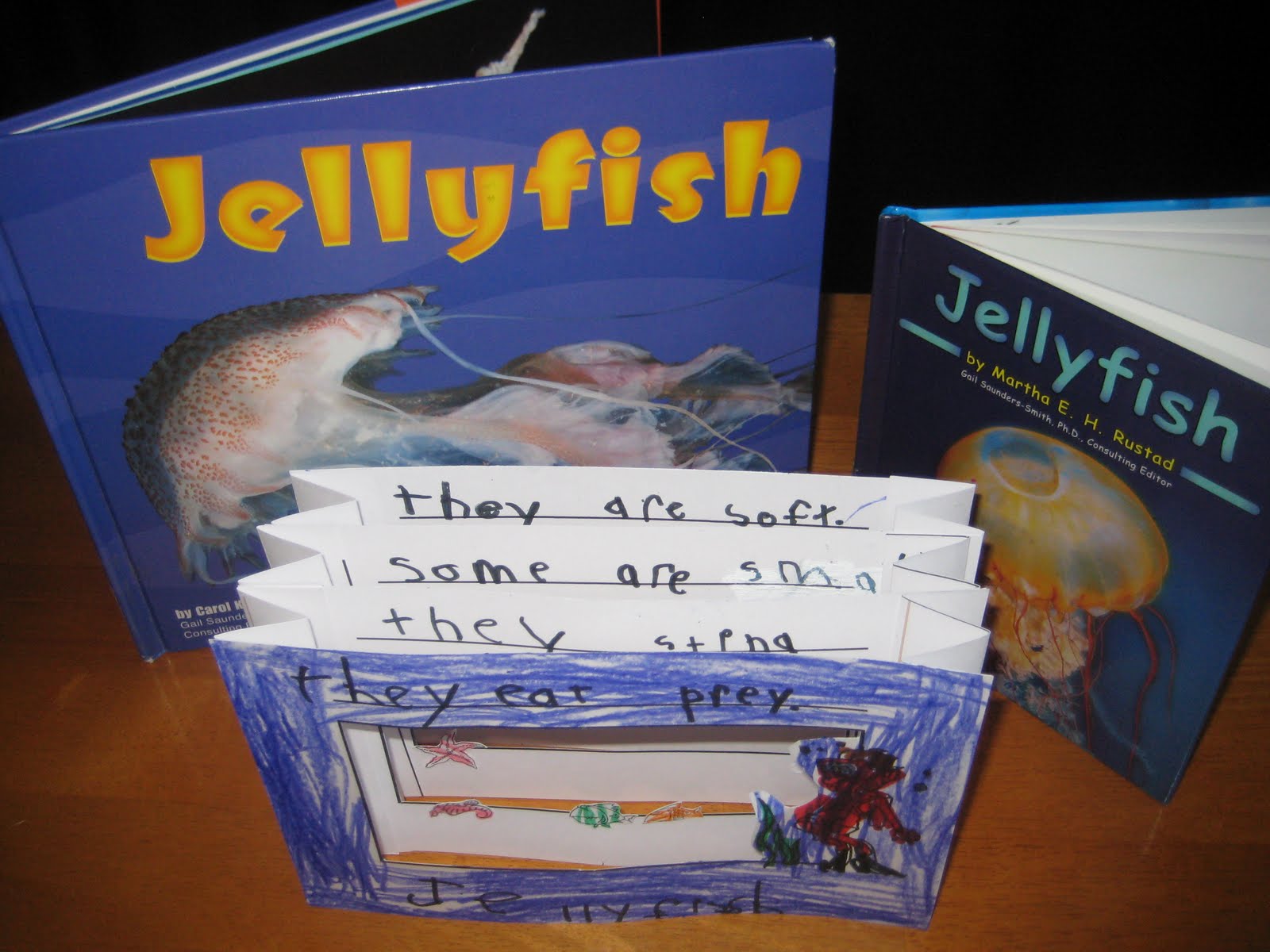
Jellyfish Tunnel Book

When I asked my son what he wanted to learn about, I don’t know what I was expecting him to say. But “jellyfish” certainly wasn’t it.

Our local library was equipped with tons of books, but the real conundrum was what to do other than just read them. That’s when I stumbled on Teach Kids Art, a wonderful resource written by a California blogger whose tunnel books were the ideal way to take learning about jellyfish beyond books. Check out the original post here.

Before my son dug out his art supplies, though, we read two great books, both titled “Jellyfish” by authors Martha E.H. Rustad and Carol K. Lindeen. These books feature amazingly beautiful pictures of jellyfish both big and small and are ideal for early readers like my son.

Once we’d learned a thing or two, I gave my son three pieces of cardstock which had a rectangle cut out in the center (the “cover” also included a scuba diver) and another piece with no cut-out that included a jellyfish graphic. Download a PDF of the front and back pages of our jellyfish book and/or blank pages by clicking on the red words in this sentence.

On the top of each of the four cards, he wrote a short fact he’d learned about jellyfish. Then he colored the jellyfish and scuba diver as well as some graphics of fish which he glued to the edges of the window on the second and third pages.

Next, I cut two 8 ½ x 11-inch pieces of cardstock in fourths. He folded six pieces in half and then folded the edges back to meet the folds again. Lastly, he glued these between the pages of his tunnel book.

When it was complete, he could look down on his book and read his jellyfish facts or look through his book to see the fish and jellyfish scene.


To say that my son loved this activity is an understatement. He was enamored with the finished product and couldn’t wait to show off his creation.

Thanks Teach Kids Art for helping me teach my son about jellyfish!

Wednesday, June 15, 2011

Dinosaur Counting and Measuring

In the second book of the Dinosaur Cove series, author Rex Stone’s main characters, Jamie and Tom venture back to Dino World on a mission to make a map; it was their quest in “Charge of the Triceratops” that inspired this activity.


I created a worksheet mapping out some of the landmarks mentioned in the story and in order to answer a series of questions, my son would need to count the steps from one to another.
Download this worksheet here. 

After counting his way around Dino World, I gave him two large dinosaur footprints I’d cut from posterboard; I used the theropod footprint on NestlĂ© Family’s website as a guide. The finished footprints were approximately 20 inches in height and 15 1/2 inches wide (I estimated the size based on a photo I found of a person standing with one foot inside a theropod footprint).

We talked about how the T-Rex was a theropod, how big their feet were, and how large their stride must have been.


Lastly, he answered some questions I’d prepared, estimating how many of his own feet would fit inside a theropod footprint and measuring with the “footprints” how many steps it would take a T-Rex to get around our house.

Download this worksheet here.

This was a fun activity to get my son counting and measuring and helped us both realize just how big dinosaurs really were.

Monday, June 13, 2011

Planets Winding Word Puzzle

This activity was inspired by a game on the back of a kid’s meal menu. No joke. 


I used a book my son picked out earlier this year at the school book fair on the 8 planets in our solar system, to produce a series of word clues.

Before we started the puzzle, we read "8 Spinning Planets" by Brian James. Then, I explained the activity and gave my son his markers to get started. He needed to begin at the START square and count spaces down, right or left following each line of the directions, and write down the words he landed on as he wound his way around the puzzle page. The words formed a complete sentence – a clue – about one of the planets in our solar system. An example follows:
Right 4 spaces.
Down 3 spaces.
Left 4 spaces.
Down 3 spaces.
Right 6 spaces.
CLUE: You call this planet home.
ANSWER: Earth

When my son landed on the correct space, he colored it using a different color for each clue. He crossed off each line of the directions after it was completed. After he wrote all the words from the clue down, he answered, "What planet am I?" When he wasn't absolutely sure of the answer, we looked back at the book.


I wrote clues for all 8 planets, although our time was limited and we only completed the first three. The clues and answers follow:

#1  Icy rocks make up my rings. ANSWER: SATURN
#2  I am made of gas and spin on my side. ANSWER: URANUS
#3  I am the red planet with two moons. ANSWER: MARS
#4  I spin fast and am the biggest planet. ANSWER: JUPITER
#5  It is hot and dry here every day. ANSWER: VENUS
#6  I am the closest planet to the sun. ANSWER: MERCURY
#7  You call this planet home. ANSWER: EARTH
#8  It is cold here since I am so far from the sun. ANSWER: NEPTUNE

Download your own Planets Winding Word Puzzle Grid and Directions today. This was a fun activity that combined counting, reading, learning about space, right/left practice and writing.

You can do this activity on virtually any topic, using any short sentences that you’d like. A blank winding word puzzle grid is available for download here.